One shared space
for the whole household.
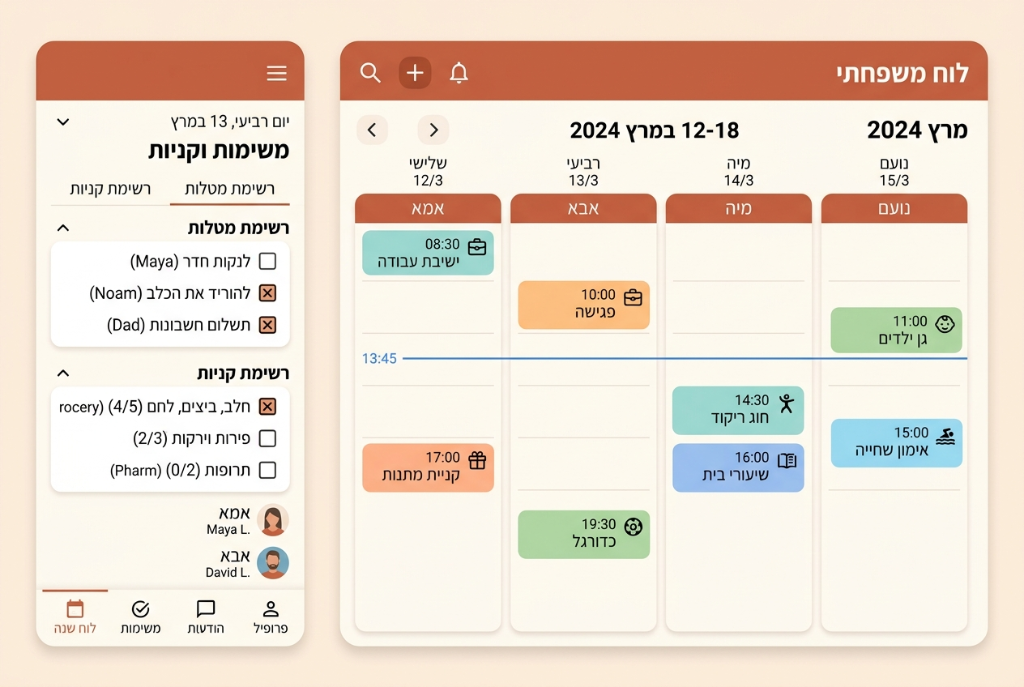
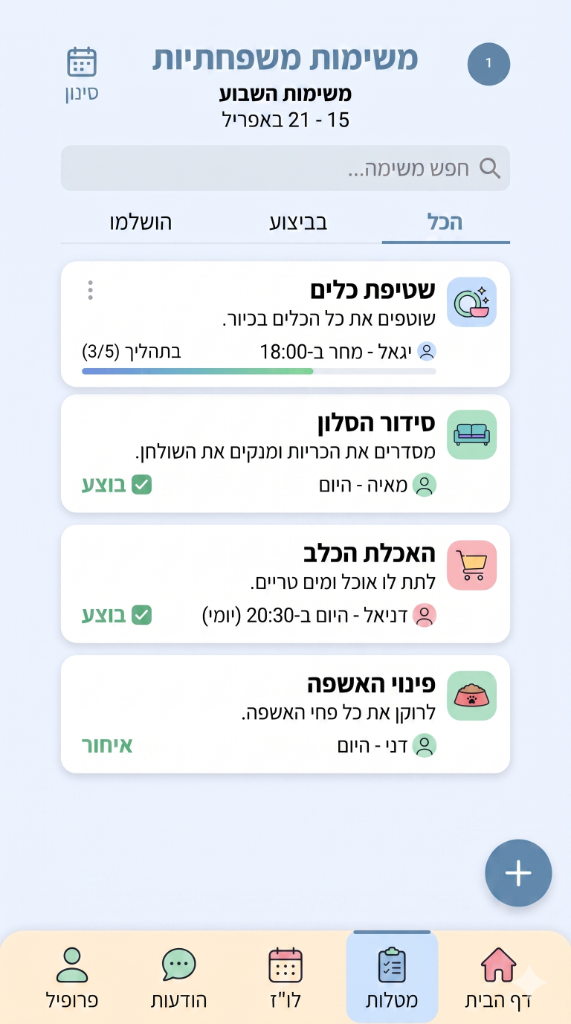
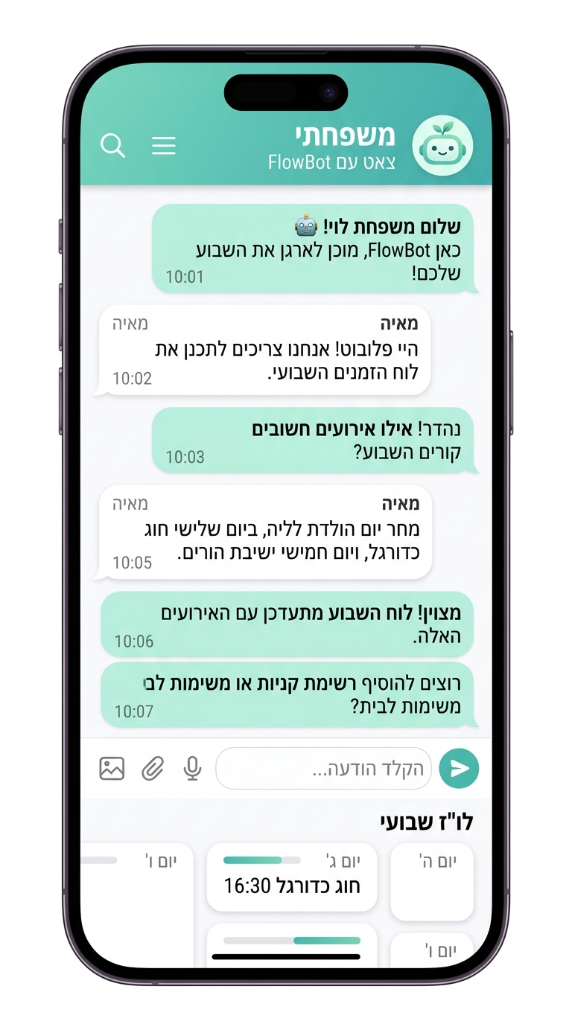
A calendar, chores with points and levels, family members and an AI assistant — together in one Hebrew/RTL-first hub, so nothing falls through the cracks.

This week
Chores & points
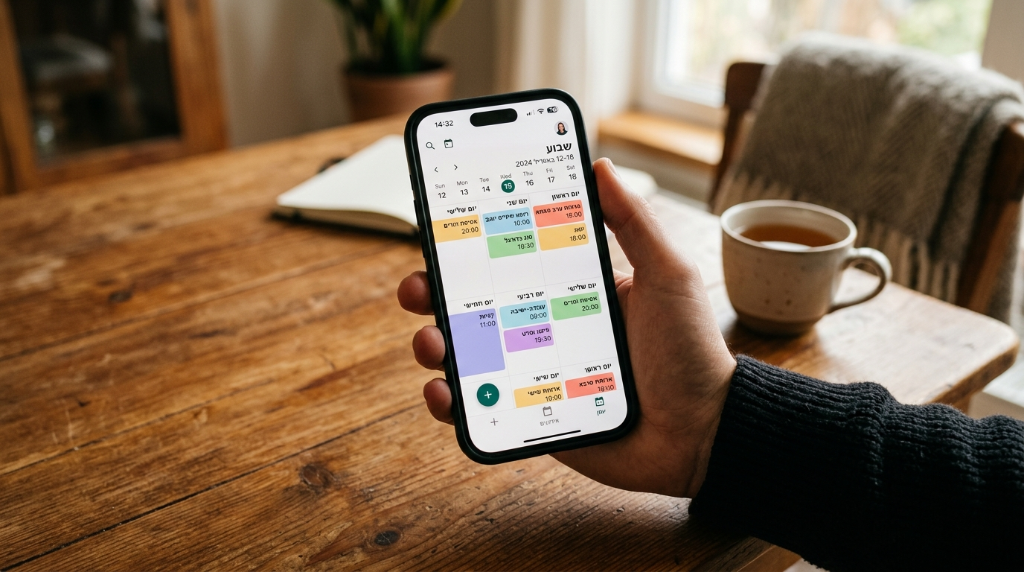
The problem we noticed
Running a household is a coordination problem spread across too many tools and too many heads. Parents juggle kids' schedules, chores, shopping lists, appointments and reminders — across a shared paper calendar, a fridge whiteboard, scattered group chats and three different apps.
Things fall through the cracks: a chore nobody did, an appointment nobody logged, a "who's picking up the kids?" message lost in a thread. Existing tools are usually a shared calendar only, or a chore chart only — rarely a single hub that ties it all together, and few are built for Hebrew/RTL families.
Market research
The global parenting/family-apps market is ~$1.71B (2025), heading to ~$3.1B (2030) at ~12.6% CAGR (market.us 2025; Business Research Insights 2025; Coherent Market Insights 2026 — multiple firms converge on ~$1.7B 2025 / low-teens CAGR). The category leadership is contestable — users who adopted "Cozi alternatives" are turning them into the new defaults. That churn at the top is the opening.
Cozi — Gold $39/yr
Category leader, 12M+ families — calendar, lists and chores. Gold premium $39/yr (Cozi 2026 official pricing).
TimeTree & Maple
Fast-rising "new defaults." TimeTree premium $44.99/yr (TimeTree 2026); Maple+ ~$40–76/yr (growmaple.com 2026).
FamilyWall — $44.99/yr
All-in-one hub; premium $44.99/yr (FamilyWall 2026 official pricing). Plus niche chore/organizer players (OurHome, Nori, FamCal…).
Our differentiated angle
A true all-in-one hub (calendar + gamified chores + members + AI) rather than a single-purpose tool — built Hebrew/RTL-first, where Western, English-first incumbents are weak.
On-trend, built-in
Gamified chores for kid engagement (integrity enforced at the DB layer) and an embedded AI assistant — FlowBot — with a bring-your-own-key option.

Product requirements
Functional Requirements
- Families with members, roles and a single-use, email-validated invite flow
- Chores with assignments; a points / levels / streaks system, server-enforced
- Shared calendar and events
- In-app chat + FlowBot AI scoped to a family's context
- Per-user AI settings (bring-your-own-key), ideally server-side key storage
Non-Functional & Security
- RLS-enforced data isolation per family (well-implemented today)
- No committed secrets; rotate the anon key found in
.env; gitleaks in CI - Restrict Edge Function CORS; never expose third-party AI keys to the client
- Stronger invite-code entropy + rate-limiting against family-join brute force
- Hebrew/RTL correctness is launch-critical — currently a flagged risk
- Mobile: responsive grids at 375px, 44px touch targets, skip-nav, visible focus
Market size & sizing logic
FamilyFlow sits in the parenting/family-apps market with an Israel-first wedge. Sizing uses a single ARPA of $40/yr and a single Year-3 target throughout, so TAM/SAM/SOM, the P&L and unit economics all reconcile. Each figure cites a named source or is labeled an estimate.
| Layer | Figure | Basis |
|---|---|---|
| TAM Global parenting/family apps | ~$1.7B (2025) | market.us 2025; Business Research Insights 2025; Coherent Market Insights 2026 (directional) |
| SAM Israeli families w/ school-age kids | $55.2M ~1.38M families | est. ~50% of 2.77M households (CBS 2022) × $40 ARPA |
| SOM Year-3 obtainable | $1.6M 40,000 paid | Pre-launch projection (est.) based on Israeli launch |
Our approach
All-in-one, not a single feature
Compete on breadth — calendar + gamified chores + members + AI in one app — against single-purpose incumbents.
Hebrew/RTL-first wedge
Win the underserved Israeli/Hebrew family market where English-first incumbents are weak, then expand to English markets.
Engagement via gamification
Points, levels and streaks keep kids — and therefore families — coming back. Already built and integrity-protected server-side.
AI safely; privacy as table stakes
FlowBot adds "ask your family schedule anything," with server-side keys and restricted CORS as preconditions. Close known security findings before any marketing push.
The solution
Architecture — as built
- Frontend & Rapid Prototyping: Built with Lovable using React 18 + Vite + Tailwind CSS + Shadcn/Radix (deployed as an installable PWA at familyflow.fun)
- Backend: Fully integrated with Supabase (Postgres + Row-Level Security), Edge Functions including
flowbot-chat, Vault key storage, and email queues via service-role-only RPCs
Security model — strengths today
- RLS (Row-Level Security) active on all user-data tables
prevent_role_escalationtriggers + approval workflowsprevent_points_tamperingDB triggers to block client manipulation- Atomic single-use invites with transaction-safe row locks
.env + gitleaks in CI; restrict Edge Function CORS; stop sending AI keys to the client; raise invite-code entropy + rate-limit; confirm RTL/lang.Business model & financials
Figures below are pre-launch projections (estimates) — no revenue or retention data exists yet. One ARPA of $40/yr is used everywhere; competitor pricing is from official pages, market sizing from the firms cited in Section 02/04.
Free (ad-supported)
Proposed free tier (est.): core calendar + basic chores
Premium — ₪144/yr ($40)
₪15/mo (~$4.15) or ₪144/yr ($40/yr ARPA). Proposed package assumptions (est.): ad-free, up to 8 members, unlimited calendar sync, gamified chores, school-holiday auto-sync. Priced against Cozi $39/yr, FamilyWall/TimeTree $44.99/yr (official 2026).
BYO-AI-key option
Keeps AI cost off the company P&L for power users — already supported in the product.
3-year revenue & operating profit (projection · est.)
| Metric | Year 1 | Year 2 | Year 3 |
|---|---|---|---|
| Paid family accounts (est.) | 3,000 | 15,000 | 40,000 |
| Revenue ($40 ARPA) | $120,000 | $600,000 | $1,600,000 |
| Total OpEx (est.) | $430,400 | $490,640 | $609,472 |
| EBITDA (est.) | −$310,400 | $109,360 | $990,528 |
OpEx built on Israeli cost base — salaries as commercial estimates (PayScale Israel / Glassdoor IL 2026), not benchmark precision; cloud, marketing and G&A as labeled estimates.
~$133 LTV (est.)
At ~30%/yr churn (est.) → ~3.3-yr lifetime × $40 ARPA. Pre-retention-data.
$12 CAC (est.)
Blended — organic + in-household invite loop. Year-1 marketing spend implies ~$6 paid CAC.
~11× LTV/CAC (est.)
$133 / $12. All unit economics are estimates, pre-retention-data.
Future prospects
Close the gaps, test demand
Close the security/RTL findings, run a Hebrew-market beta, instrument retention, and pick and test a pricing tier.
Deepen & widen
Proactive AI nudges ("3 chores undone, soccer at 5"), Google/Apple calendar sync, expense splitting and shopping lists to match FamilyWall's breadth, English-market launch.
The household OS
From the underserved Hebrew/RTL market, expanding outward.
The single shared operating system for a household.
Calendar, tasks, money — and an assistant that quietly keeps the family coordinated.